Passphrase generator guide: what it does and when to use it
What this tool does
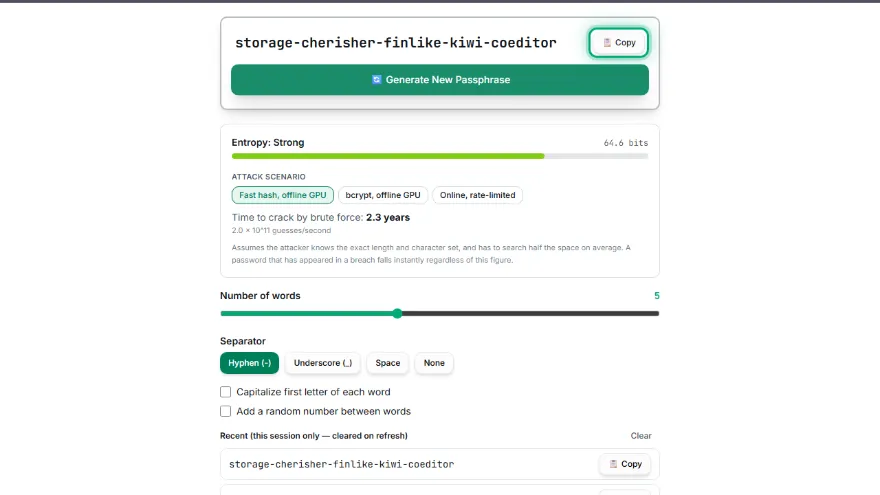
It picks words at random from the EFF Large Wordlist — 7,776 words, the number of ways five dice can land — and joins them with the separator you choose. Because every word is equally likely, each one adds about 12.9 bits of entropy, and the figure shown is calculated from exactly that. The selection uses your browser's cryptographic random number generator; nothing leaves your device.
When to use a passphrase
Choose a passphrase whenever a person, not a password manager, has to remember or type the secret.
- ✓The master password of a password manager
- ✓A computer or phone login you type every day
- ✓Disk encryption and backup keys
- ✓Not for sites with a short maximum length — six words usually run to 41–53 characters
How to create a passphrase, step by step
- 1
Choose the number of words
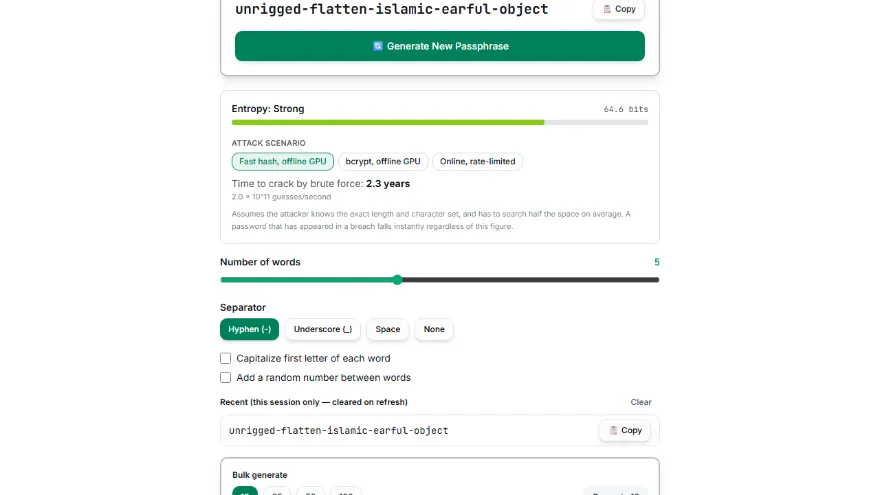
The generator starts at five. Move to six for accounts that matter — the length EFF recommends — and seven for a master password.
- 2
Pick a separator
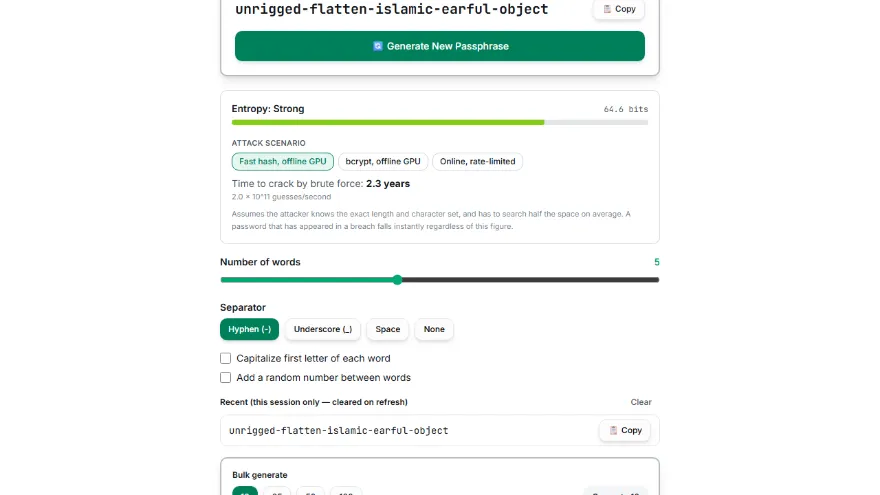
Hyphen, underscore or space. It adds almost no strength, but it keeps the words readable.
- 3
Add capitals or a number only if a site demands them
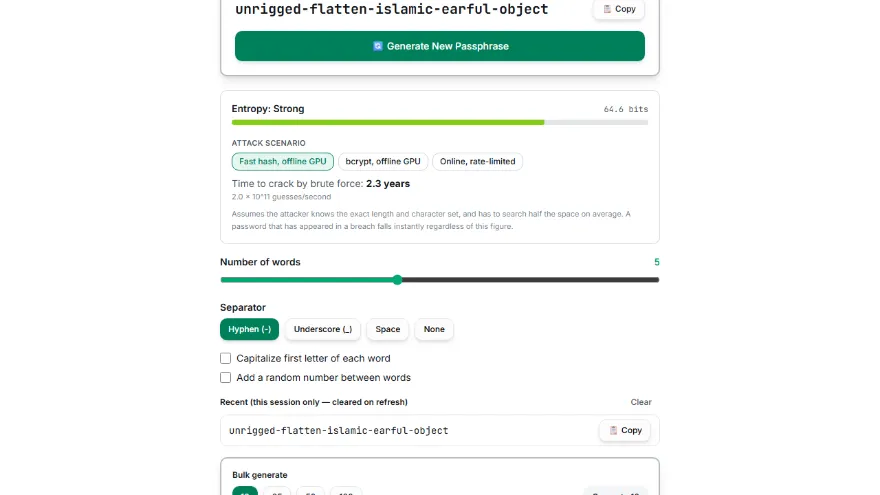
Capitalising every word adds nothing an attacker cannot predict; the inserted number adds about 6.5 bits, half a word.
- 4
Regenerate until one sticks

Choosing the most memorable of 16 results costs at most 4 bits, far less than one extra word adds.
- 5
Practise it, then store a copy
Type it a few times over the next days, and keep a copy in your password manager or a sealed paper backup.
Tips, common mistakes and the numbers behind them
How strong is each length?
An attacker is assumed to know the list and the number of words, so strength comes only from the random choice. Average times at 2 × 10¹¹ guesses per second:
- ✓4 words — about 52 bits: roughly 2.5 hours
- ✓5 words — about 65 bits: roughly 2 years
- ✓6 words — about 78 bits: roughly 17,500 years, as strong as 13 random letters and digits
- ✓7 words — about 90 bits: roughly 136 million years
Common mistakes
Almost every weak passphrase was weakened by a human after the generator produced it.
- ✓Picking the words yourself, or swapping one for a word that means something to you
- ✓Using a quote, lyric or saying — these are in attack dictionaries
- ✓Dropping a word to fit a length limit instead of switching to a random password
- ✓Reusing the same passphrase for several accounts
Sources
Word list size, per-word entropy and the six-word recommendation come from the EFF; the 64-character recommendation comes from NIST SP 800-63B-4. Character counts were measured on the word list itself. Times assume an offline attack on a fast hash at 2 × 10¹¹ guesses per second and give the average case.
Features
- ✓Words drawn at random from the EFF Large Wordlist — 7,776 words, about 12.9 bits each
- ✓Real entropy calculation, same honest methodology as Pixebag's Password Generator
- ✓3 to 8 words, with a choice of separator (hyphen, underscore, space, or none)
- ✓Optional capitalization and a random inserted number for extra strength
- ✓Session-only history of your last 10 generated passphrases — never stored, gone on refresh
- ✓Bulk generation (10/25/50/100) with copy-all, .txt and .csv download
- ✓Runs entirely in your browser — nothing is ever uploaded or logged
Frequently Asked Questions
What is a passphrase?
A passphrase is a password made of several words chosen at random, such as five or six words joined by hyphens. Its strength comes from the random selection, not from the words themselves, so an attacker who knows the word list still has to try every combination. It is longer than a classic password but much easier to remember and type.
How many words should a passphrase be?
Six words is the EFF's recommendation for most uses, giving about 77 bits of entropy from its 7,776-word list. Five words (about 65 bits) is reasonable for everyday accounts on services that store passwords well, and seven (about 90 bits) suits a password manager's master password or disk encryption. Each extra word adds about 12.9 bits.
Passphrase vs password: which is more secure?
At equal entropy they are equally secure: six random words and 13 random letters and digits both carry about 77 bits. A random password packs that strength into fewer characters, which suits anything stored in a password manager. A passphrase wins wherever a person has to remember or type the secret, because people actually use it correctly.
How long is a passphrase in characters?
The EFF words are 3 to 9 letters long, about 7 on average, so six words with hyphens usually come to 41–53 characters. NIST SP 800-63B-4 recommends that services accept at least 64 characters precisely to support passphrases. If a site caps passwords at 16 or 20 characters, use a random password there instead of shortening the phrase.
Can I choose the words myself?
You can, but it removes most of the security. People gravitate to common, related and meaningful words, and attack dictionaries are built from exactly those choices. The entropy figure is only true when software picks every word at random.
Do capital letters or numbers make a passphrase stronger?
Capitalising every word adds nothing, because the pattern is predictable. The optional two-digit number adds about 6.5 bits — roughly half of what one more word adds. Use them when a site insists on capitals or digits, and add a word when you want more strength.
Where does the 7,776-word list come from?
It is the EFF Large Wordlist, published by the Electronic Frontier Foundation in 2016 under a Creative Commons Attribution licence. Its size is 6⁵, so five rolls of a normal die select one word, and the EFF removed words that are hard to spell, easily confused or offensive. This generator uses the same list with a cryptographic random number generator instead of dice.
Is the passphrase generated privately?
Yes. Word selection happens entirely in your browser using its cryptographic random number generator. Nothing is sent to a server, logged or kept after you close the tab.